From Glory to Gravel: Tracing the Afterlives of America's Most Beloved Kinetic Sculptures
There's a specific kind of melancholy that hits when you ask a veteran kinetic racer what happened to their old machine. The pause before the answer tells you everything. Sometimes it's pride — the thing is hanging in a gallery somewhere, or parked in a children's museum lobby where kids climb on it every weekend. Sometimes it's a wince. "It's, uh... still in the garage. Mostly."
The kinetic sculpture racing world produces extraordinary objects. These aren't just vehicles; they're years of obsession compressed into welded steel, painted foam, and borrowed bicycle parts. They carry names, personalities, and sometimes their own fan followings. But the racing circuit has never had a great system for tracking what becomes of them once the race is run. So we decided to do a little forensic digging.
What we found is a genuinely strange map of destinations — museums, scrapyards, coastal towns, college campuses, private collections, and at least one confirmed spot at the bottom of Humboldt Bay.
The Museum Pipeline: Rarer Than You'd Think
The dream ending for any kinetic sculpture is a permanent museum installation. It's validation, preservation, and a kind of immortality. The problem? It almost never happens as cleanly as builders hope.
Museums that do acquire kinetic pieces — the Exploratorium in San Francisco, various folk art institutions, a handful of regional science centers — tend to be selective to the point of ruthlessness. They want sculptures that photograph well, survive handling, don't require constant maintenance, and fit their existing programming. A 14-foot aluminum crab that needs six people to operate and sheds bolts in humidity? Probably not making the cut.
When acquisitions do happen, they're often the result of personal relationships rather than formal processes. A builder who knows someone on a museum board, or a race that has an institutional sponsor willing to advocate — that's usually the path. The sculptures that end up under proper lighting with interpretive placards next to them are the lucky few, and luck had a lot to do with it.
The Backyard Tier: Honored but Homeless
For every sculpture in a museum, there are probably twenty living out their retirement in someone's yard or workshop. This is actually more common than you'd expect, and it's not always a sad story.
A lot of builders genuinely want their machines close. After years of construction, racing, and repair, there's a relationship there that's hard to explain to people outside the community. The sculpture isn't just an object — it's a collaborator. Letting it go to a stranger, even a well-meaning one, can feel wrong.
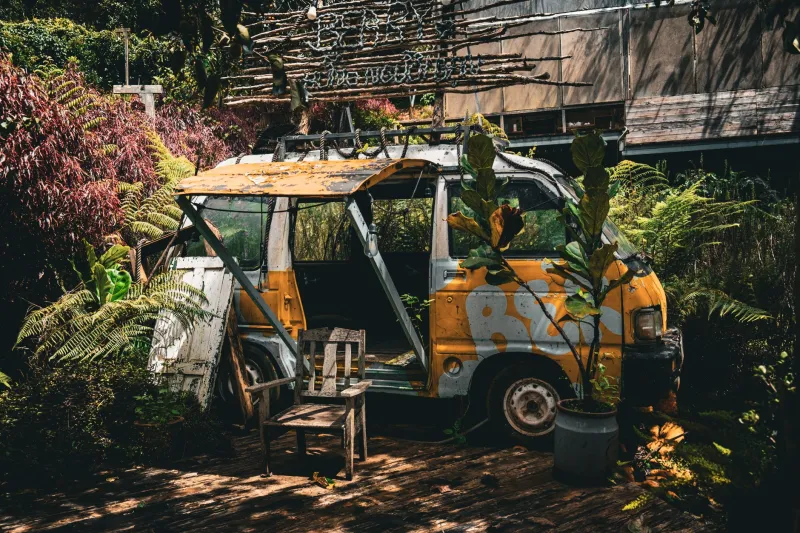
These backyard sculptures often become neighborhood landmarks. In Ferndale, California — home to one of the oldest kinetic races in the country — it's not unusual to spot retired racers rusting beautifully in front yards, wearing hand-painted signs or draped with holiday lights in December. Locals know them by name. Kids grow up with them. They become part of the town's unofficial visual identity in a way that no museum acquisition could replicate.
The trade-off, of course, is preservation. Weather is not kind to foam, paint, or exposed metal. A sculpture that looked spectacular on race day can look genuinely rough after five Pacific Northwest winters. Builders who go this route are essentially choosing intimacy over longevity.
The Parts Harvest: When Sculptures Become Donors
Here's the fate nobody talks about at awards ceremonies: cannibalization. A significant number of kinetic sculptures don't end anywhere — they get taken apart and redistributed. Wheels go to the next build. The drivetrain gets repurposed. The structural frame becomes something else entirely.
This is actually a deeply practical and, in its own way, philosophically interesting outcome. The kinetic racing community runs heavily on salvage culture. Materials are expensive, good mechanical components are hard to find, and there's a long tradition of builders passing parts down through generations of machines. In that context, a sculpture that gets harvested for parts isn't dying — it's contributing to the next thing.
Some builders are deliberate about this. They design with disassembly in mind, using fasteners instead of welds where possible, choosing standard-size tubing that can be recut and reused. When the race career is over, they hold what amounts to a parts wake: invite the community, let people take what they need, keep a few meaningful pieces as mementos.
It's a very kinetic-racing way to handle mortality.
The Institutional Adoption: Colleges, Libraries, and Civic Spaces
There's a middle tier between museum acquisition and backyard retirement that doesn't get enough credit: institutional adoption by schools, libraries, civic centers, and similar organizations. It's a genuinely good outcome that happens more often than people realize.
Community colleges with art or engineering programs are particularly receptive. A kinetic sculpture makes a fantastic teaching tool — it's a real object built by real people that demonstrates principles of mechanical advantage, material science, and design iteration. Having one in a workshop or atrium signals something about the institution's values. Several racing teams have successfully donated their machines to local schools, where they become permanent fixtures and occasional classroom subjects.
Public libraries and community centers have also stepped up in some cases, particularly in towns where kinetic racing has strong local roots. These aren't glamorous placements, but they're good ones. The sculpture stays visible, stays accessible, and stays connected to the community that cheered for it.
The Ones That Didn't Make It
And then there are the losses. Sculptures destroyed in workshop fires. Machines that got too expensive to store and ended up in dumpsters. One particularly famous Humboldt race entry that took on too much water during the ocean crossing portion and never came back up — a story that gets told at races with a mixture of horror and reverence.
These losses hit the community hard, especially when the sculpture had a long race history or a devoted following. There's no official registry, no formal preservation effort, no systematic way to prevent a significant piece of kinetic art history from simply disappearing. A few dedicated community members have tried to document sculptures through photography and oral history, but it's informal, underfunded, and always racing against time.
What Determines the Outcome?
After talking to builders, race organizers, and a few museum professionals, a few factors keep coming up as the real determinants of a sculpture's fate.
Scale matters enormously. Smaller sculptures are dramatically easier to store, transport, donate, and preserve. The giant, spectacular machines that win races and go viral are also the hardest to rehome.
Builder networks matter just as much. Sculptures built by people with connections to institutions — artists with gallery relationships, engineers with university ties, community organizers with municipal contacts — have far better odds of finding dignified retirement than machines built by talented but isolated individuals.
And timing matters in a way that's almost cruel. A sculpture that's still in good condition when the builder decides to move on has options. One that's been sitting in a leaky shed for three years while the builder figured out what to do with it? The options have narrowed considerably.
The kinetic racing world produces more extraordinary objects than it has infrastructure to preserve. That's the honest bottom line. Until someone builds a better system — a registry, a network of institutional partners, some kind of community archive — the fate of these machines will continue to depend heavily on luck, timing, and who happens to know whom. Which, come to think of it, sounds a lot like the races themselves.