Napkin Doodle to Finish Line: The Secret Design Journey of a Kinetic Sculpture
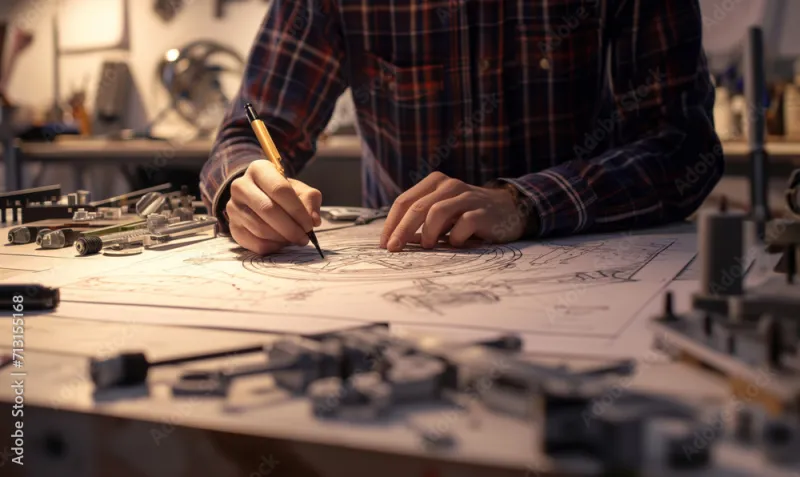
Photo: artist engineer sketching blueprint mechanical sculpture workshop, via as2.ftcdn.net
You've seen them roll past on race day—gleaming, weird, wonderful machines that look like they escaped from a dream. A 12-foot flamingo balanced on bicycle wheels. A Viking longship that actually floats. A neon caterpillar with 40 independently moving legs. What you don't see is the six months of arguments, failed prototypes, late-night fixes, and hard-won breakthroughs that got each one to the starting line.
We went behind the scenes with several kinetic sculpture builders at different stages of their creative process. What they described wasn't just an art project—it was a full-blown engineering odyssey.
The Idea: Where Chaos Is the Point
For most teams, the design process starts somewhere gloriously chaotic. "We basically do a brainstorm session where no idea is too dumb," says Marcus Tillman, a veteran builder from the Humboldt Kinetic Grand Championship who's been competing for over a decade. "Someone says 'giant shrimp,' someone else says 'but what if the shrimp is also a submarine,' and we just keep going until something clicks."
That "click" moment is harder to engineer than it sounds. The idea has to be visually striking enough to wow spectators, but it also has to be physically buildable by a team of mostly volunteers working in someone's garage. It has to float, roll across sand, and survive a mud bog—all in the same afternoon. The concept sketch isn't just art direction; it's the first constraint.
First-time builder Priya Nanthakumar, who debuted at the Baltimore Kinetic Sculpture Race last year with her team's "Solar Jellyfish" entry, keeps a running notes app full of ideas she's collected over months. "I had this jellyfish concept for two years before I had a team to build it with," she says. "The sketch I started with looked nothing like what we ended up racing, but it gave us a north star."
The Pivot: When Physics Ruins Everything
Here's the part they don't show you in the race-day highlight reels: the moment when the beautiful idea runs headlong into an immovable law of physics.
For Tillman's team, that moment came during their "Deep Sea Diner" build—a fully themed 1950s diner mounted on a human-powered amphibious frame. The original design called for a flat-bottomed hull, which looked great on paper. In the water, it spun like a top. "We lost about three weeks of build time redesigning the hull," he says, laughing now in the way you only can once the race is over. "We ended up basically copying the pontoon geometry from an old fishing boat design we found at the library."
This kind of pivot is so common it's practically a rite of passage. The design process for a kinetic sculpture isn't linear—it loops back on itself constantly. A decision about weight distribution might force a change in the frame material, which changes the budget, which changes what decorative elements are even possible. Nanthakumar describes it as "playing three-dimensional chess where someone keeps adding new rules."
The builders who thrive are the ones who treat these pivots as creative fuel rather than setbacks. "Every constraint is actually a design prompt," says Tillman. "When we couldn't make the flat hull work, we had to get creative, and the pontoon solution actually made the whole thing look cooler."
The Prototype Phase: Where Duct Tape Is a Legitimate Engineering Tool
Most serious teams build at least one rough prototype before committing to the final structure. These test rigs are often hilariously crude—PVC pipe, zip ties, cardboard mockups—but they answer critical questions that no amount of sketching can resolve.
How does the weight actually distribute when three people are pedaling? Does the steering mechanism respond fast enough to navigate a tight turn? Will the decorative elements survive wind at speed without becoming projectiles?
Nanthakumar's team built a stripped-down "skeleton" version of the Solar Jellyfish three months before race day, just to test the drivetrain and float capacity. "It looked terrible. Just bare metal and pool noodles," she laughs. "But we found out our original gear ratio was completely wrong. If we'd discovered that on race day, we'd have been done."
For championship-level teams, this phase can involve surprisingly sophisticated analysis. Some builders use basic CAD software to model stress points on the frame. Others do actual buoyancy calculations to make sure their sculpture won't sink in the water crossing—a very real and very embarrassing possibility.
The Final Push: When Art and Engineering Become the Same Thing
In the last weeks before a race, something interesting happens in most build teams. The boundary between the artistic and engineering decisions starts to dissolve. The color of a panel matters because it affects how the judges perceive the sculpture's theme, but it also affects heat absorption on a sunny race day. The angle of a decorative fin is chosen for visual drama, but it also needs to clear the ground on the sand crossing.
Tillman calls this phase "the beautiful crunch." "Everything is connected to everything else. You can't make a purely aesthetic choice without it having some mechanical consequence, and vice versa. That's actually what makes kinetic sculpture design so different from regular art or regular engineering."
For Nanthakumar, the final week before Baltimore was a blur of late nights and last-minute decisions. One of the jellyfish's translucent panels cracked during a test run four days before the race. The replacement material they sourced wasn't quite the same color. "We ended up leaning into it—made it look intentional, like the jellyfish had a bioluminescent spot," she says. "The judges actually mentioned it specifically as a design highlight."
That's the thing about kinetic sculpture design: the process never really ends cleanly. The race itself is just the deadline that forces you to stop iterating. What crosses the finish line is always a living document—a record of every decision, compromise, and happy accident that happened between that first napkin sketch and the starting gun.
And somehow, every single time, it's more magnificent than the original drawing.