Off the Books and Under the Radar: The Shadow Race Scene Where Anything Goes
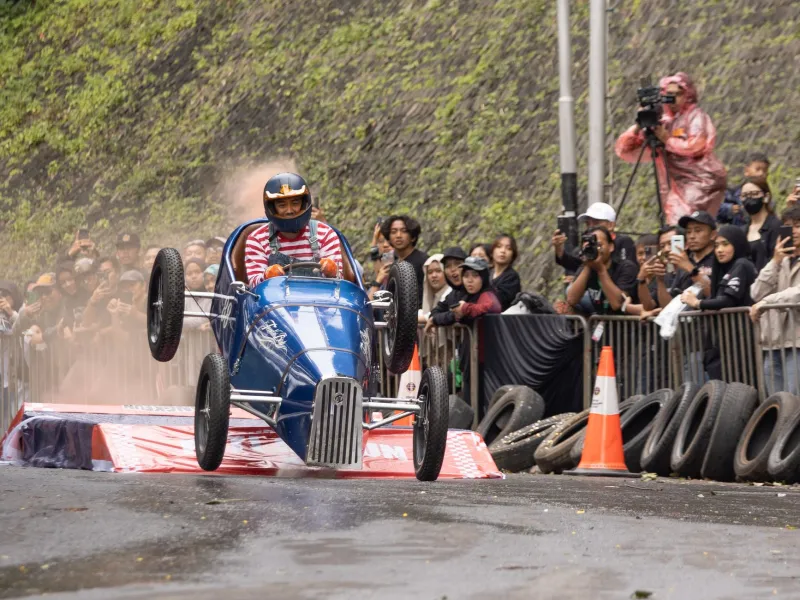
Somewhere in a field outside a mid-sized American city, a machine that looks like a cross between a deep-sea submersible and a carnival ride is attempting to cross a drainage ditch. There are no judges. There are no entry fees. There are maybe forty people watching, half of them holding beers, and every single one of them is grinning like they just got away with something.
Welcome to the shadow side of kinetic sculpture racing.
The Reject Pile Has Its Own Race
Official kinetic sculpture races — the sanctioned, organized, deeply beloved events that define this sport — run on rules. Those rules exist for good reasons: safety, fairness, structural integrity, and the basic requirement that a machine actually be human-powered. But rules have edges, and some builders spend their entire creative lives finding those edges and pushing past them.
When a design gets flagged or disqualified by an official race committee, the builder usually has two options. They can modify the machine to comply. Or they can find somewhere else to run it.
A surprising number choose the second option.
"We call it the reject circuit," says one veteran builder from the Pacific Northwest who asked not to be named because, as he put it, "I still race officially and I'd like to keep doing that." "It's not organized. There's no governing body. Someone just has land, someone else has a machine that got turned away somewhere, and you figure it out."
These gatherings range from genuinely chaotic backyard experiments to surprisingly well-organized regional meetups with their own informal traditions. What they share is a deliberate absence of official oversight — and a willingness to let things get weird.
What Gets Banned, and Why
To understand the underground scene, it helps to understand what tends to get rejected from sanctioned races in the first place.
Some disqualifications are straightforward: machines that use combustion engines, designs that pose obvious hazards to bystanders, or entries that simply can't be piloted by human power alone. Those are the easy calls.
But plenty of rejections happen in murkier territory. A machine might be technically human-powered but use an energy storage mechanism — springs, flywheels, compressed air — that the rules committee considers a gray area. A design might be structurally sound but so large or unwieldy that it creates safety concerns for other racers on a shared course. Or a concept might simply defy easy categorization, and committees, being human, sometimes default to "no" when they can't find a clear "yes."
"I had a machine turned away because the judges couldn't agree on whether it counted as floating or just... falling very slowly," says Dara Okonkwo, a fabricator from Ohio who has competed in official races for over a decade. "It crossed water. It didn't sink. But apparently the method was controversial." Her machine, a low-slung catamaran-style sculpture with an unusual hull geometry, has since competed in three unofficial events. It has never sunk.
The Innovation Pipeline Nobody Talks About
Here's where things get genuinely interesting: the underground circuit isn't just a dumping ground for failed ideas. It's increasingly functioning as an R&D pipeline.
Several builders and a handful of longtime race observers have noted a pattern over the years. A concept gets rejected or flagged at official events. It gets tested and refined in informal settings. The builder works out the kinks. And then, sometimes years later, a modified version of that same concept shows up in sanctioned competition — cleaned up, tamed down, and suddenly very competitive.
"The sand wheels are a perfect example," says one race committee member who has worked with multiple official events and spoke on background. "Wide, low-pressure tires for sand crossings — that whole design philosophy got refined outside of official races before it became mainstream. People were experimenting with it in fields before it was ever on an official course."
Not every innovation makes the jump. Some ideas that work beautifully in a flat field fall apart on an actual race course with its varied terrain and unpredictable conditions. The unofficial circuit, ironically, can be a gentler testing environment precisely because the stakes are lower.
Rebellion or Just Enthusiasm?
It's tempting to frame the underground scene as a form of creative rebellion — builders sticking it to the establishment, running their machines on their own terms. And sure, there's some of that energy. The people who show up to these events tend to skew toward the more ornery end of the builder spectrum.
But spend any time talking to participants and a more complicated picture emerges. Most of them aren't anti-establishment. Many are deeply committed to official racing and return to sanctioned events season after season. What they're really after is something harder to find in a regulated competition: the freedom to fail spectacularly.
"In an official race, a catastrophic failure is a problem," says Marcus Thielen, a Wisconsin builder who has been involved in informal kinetic events for about eight years. "Out here, a catastrophic failure is the highlight of the day. Everyone learns something. Nobody gets hurt — or at least, nobody gets hurt badly. And you go home knowing exactly what not to do next time."
That ethos — failure as data — is deeply familiar to anyone who's spent time in engineering or maker communities. The unofficial circuit, in that sense, is less a shadow world and more an extended workshop.
The Safety Question
It would be dishonest to skip past the risks. These events operate without safety infrastructure, without medical personnel on standby, and without the liability frameworks that official races use to protect both participants and bystanders. Machines that have been rejected for safety reasons are, by definition, machines that someone decided posed a risk.
Most participants are aware of this and take it seriously in their own way. Events tend to be small and invitation-based, keeping the audience limited to people who understand what they're watching. Courses are chosen to minimize hazards. And there's a strong informal norm against testing anything that could hurt a bystander.
"We're not idiots," Okonkwo says. "We know what we're doing. But we also know that 'what we're doing' is riding experimental machines into water on purpose, so we keep the guest list tight."
Where This All Goes
The relationship between official kinetic racing and its unofficial shadow scene is genuinely symbiotic, even if neither side fully acknowledges it. Sanctioned events get a steady trickle of refined, battle-tested innovations from builders who worked out the rough edges somewhere else first. The underground circuit gets a sense of purpose — it's not just chaos, it's research.
Whether that relationship ever becomes more formal is an open question. Some builders would love to see a recognized "experimental class" at official events, a space where boundary-pushing designs can compete under supervision without needing to meet the same standards as the main field. Others think the whole point of the shadow scene is that it stays unofficial.
For now, somewhere in a field, a machine that probably shouldn't exist is doing something that probably shouldn't work. And forty people are watching, and every single one of them is learning something.
That feels pretty kinetic to us.