Mud, Wheels, and Millions of Views: How Kinetic Racing Conquered the Internet
Somewhere between the sand pit and the water crossing, kinetic sculpture racing became a content machine.
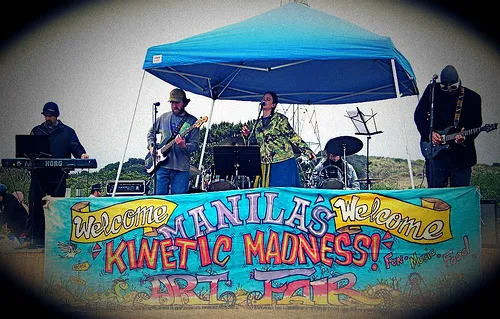
It didn't happen all at once. For decades, the Kinetic Grand Championship and its regional cousins operated as beloved local spectacles—deeply weird, fiercely creative, and almost entirely unknown outside of a tight geographic and cultural orbit. The races drew devoted regulars, a few curious tourists, and the occasional bewildered journalist. Then smartphones got better, short-form video exploded, and someone posted a clip of a ten-foot mechanical crab attempting a beach crossing.
The comments went feral. In the best way.
The Clip That Changes Everything
Ask people in the kinetic racing community when they first noticed something had shifted, and many of them point to a specific type of moment: the water crossing video. There's something about watching a gloriously impractical land vehicle—a dragon, a giant snail, a levitating donut—attempt to become a boat that hits a primal nerve on social media.
"Water crossings are inherently dramatic," says Jordan Meeks, a content creator who started documenting races in the Pacific Northwest about four years ago. "You've got this beautiful, ridiculous thing, and then it either floats or it doesn't. That's a complete story arc in about forty-five seconds. TikTok was basically designed for that."
Meeks' early kinetic racing videos pulled modest numbers—a few thousand views, mostly from people who already knew what the races were. Then one clip of a sculpture slowly, magnificently sinking during a water crossing hit the For You page and everything changed. "I woke up to like 800,000 views and my phone was completely unusable," he says. "The comments were people asking 'what IS this' and 'why have I never heard of this before.' That's when I realized the format had real reach."
Why This Sport Is Built for Visual Media
Kinetic sculpture racing has qualities that most niche sports would kill for on social platforms. The machines are visually extraordinary—bright, large-scale, and often moving in ways that seem to defy expectation. The settings are cinematic: crashing surf, open sand, muddy bogs, downtown streets lined with crowds. And the human element is right there on the surface. Pilots are visible, often costumed, frequently struggling, and almost always grinning.
Instagram discovered kinetic racing slightly before TikTok did, largely through photographers who stumbled onto the events and couldn't believe what they were seeing. The still images alone—a chrome sea serpent mid-sand-dune, a team of mechanics frantically adjusting a wheel in knee-deep water—have a quality that stops a scroll cold.
"The rule I've found is: weird scale works," says Damaris Ochoa, a lifestyle photographer based in the Bay Area who has covered the Kinetic Grand Championship for the past three years. "When something is much bigger than it should be, or moving in a way that doesn't make physical sense, people can't look away. Kinetic sculptures hit both of those buttons constantly."
YouTube has developed its own kinetic racing ecosystem, leaning into longer documentary-style content. Build videos—where creators show the months-long process of designing and constructing a sculpture—pull consistent views from audiences who overlap heavily with the maker and DIY communities. A well-produced build series can clock hundreds of thousands of views before a race even happens.
The Recruitment Effect
The most tangible consequence of all this attention isn't view counts—it's bodies at the starting line.
Race organizers across the country have reported upticks in new team registrations that correlate directly with viral moments. People who discovered kinetic racing through a TikTok video have shown up to races in Humboldt County, in Baltimore, in Houston, wanting to participate rather than just spectate. Some of them have gone on to build their own sculptures.
"We had a team last year that was entirely composed of people who met in the comments section of a YouTube build video," says one race coordinator who asked to remain anonymous because she didn't want to jinx it. "They'd never met in person until they showed up with their sculpture. That would not have happened five years ago."
The demographic reach of social media has also diversified who's discovering the sport. Younger builders, builders from outside the traditional West Coast hub cities, and builders from communities that weren't previously represented in kinetic racing have all found their way in through algorithmic recommendation. The sport's longstanding ethos of radical inclusivity has gained a new delivery mechanism.
What Performs, What Doesn't
Not all kinetic content is created equal, and experienced creators have developed a fairly clear sense of what the platforms reward.
For short-form video, obstacle moments are king. Sand pits, water crossings, and the perpetually entertaining mud bog generate the most engagement—partly because they're visually dynamic, and partly because they carry genuine stakes. Will it make it? That question is irresistible.
Behind-the-scenes content performs surprisingly well on Instagram and YouTube, particularly anything that reveals the engineering logic behind a sculpture's appearance. "People love finding out that the thing is actually functional," Meeks explains. "Like, 'wait, those fins are actually doing hydrodynamic work?' That surprise is shareable."
Ochoa has found that human-focused content—pilots reacting to a successful water crossing, teams celebrating or commiserating at the finish line—generates the highest save rates on Instagram. "People connect to the emotion first, and then they want to know more about the machines. The art and the engineering come second. The people come first."
What doesn't work, creators largely agree, is anything that assumes prior knowledge. Content that leads with jargon or treats kinetic racing as already-known loses the casual viewer immediately. The most effective videos function as genuine introductions, letting the spectacle speak before explaining the context.
The Double-Edged Algorithm
It's worth being honest about the complications. Viral attention is not the same as deep community investment, and some longtime participants worry about what happens when a subculture absorbs a large wave of newcomers who arrived via fifteen-second clips.
"The spirit of kinetic racing is pretty specific," says Thibodeau, a longtime builder. "It's not just about building something cool. There's a whole philosophy around human-powered movement, creative problem-solving, not taking yourself too seriously. You can't really convey that in a TikTok."
Others are less concerned. The races themselves, they point out, do the work of transmitting culture once people arrive. And the social media content, whatever its limitations, is bringing people to the starting line who would otherwise never have found their way there.
"Every person who shows up because of a video is a person who might build something incredible," Sousa says. "I'll take that trade."
The algorithm didn't invent kinetic sculpture racing. It just finally told everyone else it existed. What happens next is still being built—in garages, in warehouses, in comment sections, and on every ridiculous, magnificent stretch of sand and water where art rolls, floats, and occasionally, gloriously, flies.